
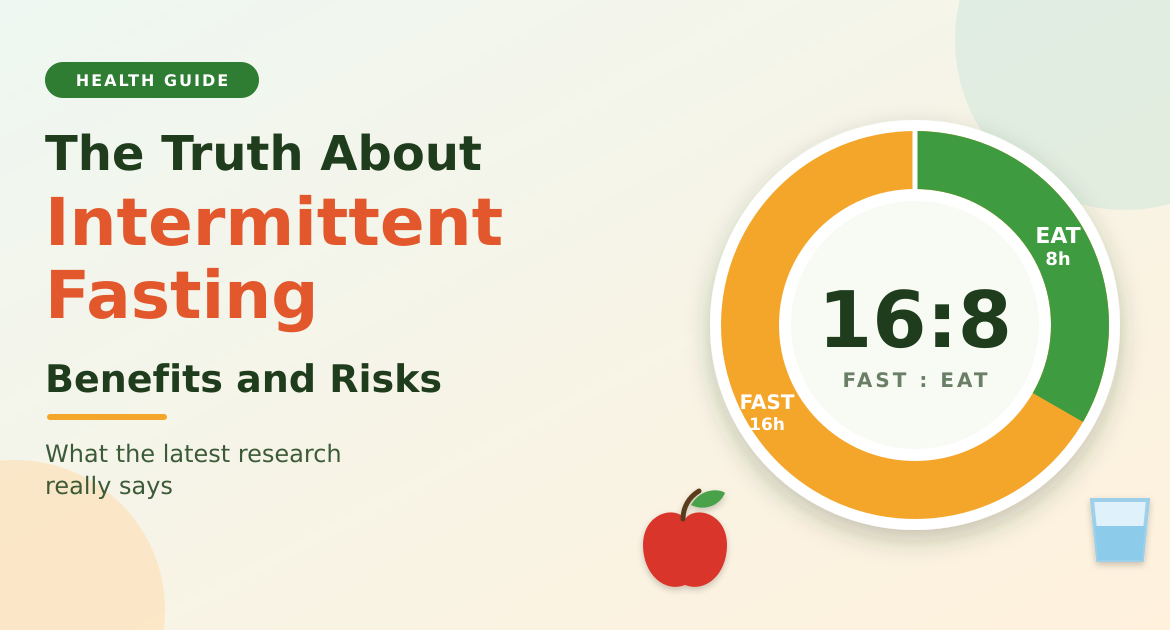
The Truth About Intermittent Fasting: Benefits and Risks
Intermittent fasting is everywhere right now, from social media feeds to doctors’ offices. Some people swear it helped them lose weight and feel sharper. Others warn that it is risky or just another diet fad. So what is the truth? In this guide, we break down the real intermittent fasting benefits and risks using recent research from Harvard, Cochrane and the American Heart Association, so you can decide if it is right for you.
What Is Intermittent Fasting?
Intermittent fasting is an eating pattern that cycles between periods of eating and periods of fasting. Instead of changing what you eat, it focuses on when you eat. According to Harvard’s Nutrition Source, there are three common types:
| Type | How it works | Example |
|---|---|---|
| Time-restricted eating (16:8) | Eat only within a set window each day | Eat between 12 pm and 8 pm, fast for the other 16 hours |
| Whole-day fasting (5:2) | Eat normally five days a week, and eat very little (about 400 to 500 calories) on two non-consecutive days | Normal meals Monday, Tuesday, Thursday, Friday and Sunday |
| Alternate-day fasting | Switch between normal days and days with one small meal (about 25% of your calorie needs) | Normal day, fasting day, normal day, fasting day |
How Does Intermittent Fasting Work?
After several hours without food, your body uses up the sugar it has stored and starts using fat for energy. Many people believe this switch is the secret behind intermittent fasting. However, most of the evidence suggests a simpler explanation: people who fast tend to eat fewer calories overall. That is why intermittent fasting often performs about the same as regular dieting in studies, as you will see below.
Intermittent Fasting Benefits: What the Research Shows
Weight Loss: Helpful, but Not Magic
Weight loss is the main reason people try intermittent fasting, so let’s look at the strongest evidence:
- A large 2026 Cochrane review analyzed 22 randomized trials with 1,995 adults who were overweight or obese. It found little to no difference in weight loss compared with regular calorie restriction. Compared with no diet at all, people who fasted lost about 3.4% more body weight.
- A 2025 BMJ review from Harvard researchers pooled 99 trials with more than 6,500 people. Intermittent fasting and calorie-restricted diets worked about equally well, and both beat diets with no restrictions. Alternate-day fasting came out slightly ahead, with about 1.3 kg more weight loss than calorie restriction.
The takeaway: one of the biggest intermittent fasting benefits is that it works about as well as other diets. It is a valid option, but it is not a shortcut.
Heart and Metabolic Health: Mixed Results
The same BMJ review found that alternate-day fasting also improved waist size, cholesterol, triglycerides and a marker of inflammation called C-reactive protein.
The picture is less clear elsewhere. Harvard’s Nutrition Source notes that in some one-year trials, changes in blood sugar and blood pressure were not significantly different from those in people following regular calorie restriction. In one trial, LDL (“bad”) cholesterol actually rose after 12 months in the alternate-day fasting group.
In other words, some intermittent fasting benefits for the heart and metabolism look promising, but the evidence is not consistent yet.
Simplicity: Fewer Rules to Follow
Many people find a clear eating window easier than counting calories. Harvard’s Nutrition Source also notes that setting a cutoff time for eating may help people who tend to snack late at night, since late eating can cause reflux and disrupt sleep.
Intermittent Fasting Risks and Side Effects
Common Side Effects
Intermittent fasting is not risk-free, and it does not suit everyone. These are the main intermittent fasting risks to know about:
- Hunger, headaches, nausea and fatigue. Trials have reported these side effects, although not consistently.
- Overeating after fasting. Long stretches without food can lead to overeating when you finally eat.
- An unhealthy focus on food. Constant attention to eating windows can become stressful for some people.
- Hard to stick with. Dropout rates in studies ranged from 0% to 65%, with no clear advantage over regular dieting.
- Difficult for frequent snackers. If you normally eat every few hours, long fasts can feel very tough.
- Unknown long-term effects. Most trials lasted only 6 to 12 months, so we don’t yet know what happens after years of fasting.
What About the Heart Death Headline?
In 2024, a study presented by the American Heart Association made headlines. It found that people who ate within a window of less than 8 hours a day had a 91% higher risk of cardiovascular death than those eating across 12 to 16 hours.
Before you panic, keep these points in mind:
- It was an observational study of about 20,000 U.S. adults, so it can show an association but cannot prove cause and effect. The authors said it “does not mean that time-restricted eating caused cardiovascular death.”
- It relied on self-reported eating habits, which can be inaccurate.
- It was presented as preliminary research at the time and had not been fully peer reviewed.
The study does not prove that fasting is dangerous, but it is a good reason to be careful and to talk with your doctor, especially if you already have heart disease.
Who Should Avoid Intermittent Fasting?
The intermittent fasting risks are higher for some people than others. According to Harvard’s Nutrition Source, these groups should not try intermittent fasting without medical guidance:
- People with diabetes, especially those who take insulin or other glucose-lowering medicines
- People with a history of eating disorders, such as anorexia or bulimia
- People who take medicines that must be taken with food
- Teenagers and children, who are still growing
- Pregnant or breastfeeding women
Anyone with a medical condition or who takes regular medication should speak with a doctor first.
A note on Ramadan: fasting during Ramadan is a religious practice and works differently from a diet plan. If you have diabetes, heart disease or another health condition, ask your doctor how to fast safely.
How to Try Intermittent Fasting Safely
If your doctor says it is fine and you want to try it, follow these steps:
- Start gently. Begin with a 12-hour overnight fast, such as 8 pm to 8 am. Move to 14 or 16 hours only if you feel good.
- Stay hydrated. Water, unsweetened tea and black coffee are usually allowed during fasting hours.
- Break your fast with a balanced meal. Choose protein, fiber and healthy fats instead of sweets or fried food. Our Food section has plenty of healthy ideas.
- Don’t overeat. Eat slowly and stop when you feel satisfied.
- Protect your sleep and stress levels. Poor sleep and high stress make any eating plan harder. Simple breathing techniques can help you stay calm.
- Stop if you feel unwell. Dizziness, fainting, a racing heart or extreme weakness are signs to eat and call your doctor.
Intermittent Fasting at a Glance
| Question | What the evidence says |
|---|---|
| Does it help with weight loss? | Yes, about as much as regular calorie restriction and more than no diet |
| Is it better than traditional dieting? | Little to no difference in most trials |
| Is it good for the heart? | Mixed results, and the long-term picture is unclear |
| Is it safe for everyone? | No. Some groups should avoid it |
| How strong is the long-term evidence? | Limited, since most trials lasted 12 months or less |
Frequently Asked Questions
Is intermittent fasting safe? For many healthy adults it appears to be safe in the short term, but it is not right for everyone, and long-term safety is not yet known. Check with your doctor first.
Is intermittent fasting better than counting calories? Not according to current research. Most trials show similar results, so the best plan is the one you can stick with.
Which type of intermittent fasting is best? There is no clear winner. The 16:8 method is often the easiest to start with, while alternate-day fasting looked slightly better for weight loss in one large review but is harder to follow.
Can I drink anything while fasting? Most plans allow water, unsweetened tea and black coffee. Avoid sugary drinks during your fasting window.
How long does it take to see results? It varies. Studies reviewed by Harvard’s Nutrition Source found a typical loss of 7 to 11 pounds over about 10 weeks, but individual results differ.